

Class News

Dick Berk ’64 discussed “AI, Criminal Justice, and the Land of the Free”
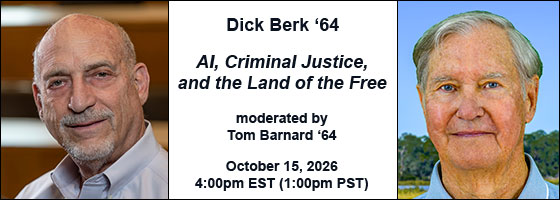
On October 15, 2026, Dick Berk ’64 was the featured speaker at a Yale ’64 Zoom event moderated by classmate Tom Barnard ’64 and attended by an audience of 95 classmates and friends. The title of Dick’s talk was “AI, Criminal Justice, and the Land of the Free.” Dick is Emeritus Professor of Criminology and Statistics at the University of Pennsylvania.
Dick received his Ph.D in Sociology from Johns Hopkins in 1970. He first used artificial intelligence (AI) in criminal-justice research when at UCLA in the 1980s, where he was awarded the title of Distinguished Professor of Statistics. His applied work in criminal justice was undertaken for the California Department of Corrections and the Los Angeles Police Department. He routinely consulted for the U.S. Sentencing Commission, the Federal Department of Corrections, and state-level criminal justice agencies around the country.
In 2006, he was hired by the University of Pennsylvania for a position in the Department of Criminology and the Department of Statistics. He continued to develop AI procedures for criminal-justice agencies including writing the code for risk assessment tools used by the Pennsylvania Department of Corrections, the Pennsylvania Parole Board, and the Philadelphia Department of Probation and Parole. Dick retired from Penn in 2023 but his work on AI procedures and criminal-justice applications continued apace. In 2025, he served on the advisory committee for the Pennsylvania State Legislature on the future of AI in the Commonwealth.
Dick’s talk included illustrations from real criminal-justice applications such as facial recognition to intimidate protesters, AI large-language models (LLMs) summarizing evidence or providing testimony, offender risk assessments to assist or replace human decisions in charging, sentencing, and parole supervision, and “embodied” AI in robotic police dogs and robotic police officers.
Below is the 80-minute video of Dick’s presentation and the subsequent Q&A session moderated by classmate Tom Barnard.