
In Memoriam

Donald B. Edwards
Don Edwards ’64 died on April 27, 2026.
Here are remembrances of Don, including his obituary, a remembrance by our Class Secretary Tony Lavely, a note from Jack Gillette, and three essays that Don wrote on the occasions of three Yale reunions.
- Obituary
- Memorial Service (video)
- Remembrance by Tony Lavely, ’64 Class Secretary
- Note from Jack Gillette
- Essay, 60th Reunion Book
- Essay, 50th Reunion Book
- Essay, 25th Reunion Book
Obituary
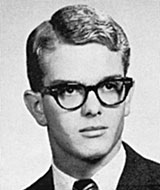
Don Edwards
1964 Yale graduation
Donald (Don) Bert Edwards died at home in Wallingford, CT on April 27, 2026 after treatment for pancreatic cancer. Don was born in Tulsa, OK in 1942 to George Bertrand Edwards and Martha Cory Edwards. After graduating from Will Rogers High School, Don traveled to Connecticut for the first time to enter Yale College with the Class of 1964, where he sang with the Yale Glee Club, Alley Cats (an a cappella group), and Battell Chapel choir, and earned a BA in History. He stayed involved with Yale throughout his life, serving on his class council and the Yale Alumni Chorus board, as well as enrolling in many lifelong learning programs.
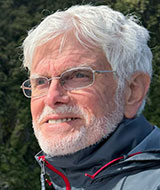
Don Edwards
in recent years
Yale was also where he made, in his words, the best decision of his life: asking out Sara (Sally) Williams Barnard, who was studying for a masters in teaching in the Graduate School, on a blind date for his senior prom. Married six months later, Don and Sally moved to New Jersey where they lived for 50 of their 57 years together. Don entered Princeton Theological Seminary but left because it was “too conservative” for him. After masters-level coursework in history at Rutgers, he went to work for the New Jersey Office of Economic Opportunity (and later Department of Community Affairs), beginning a lifelong pursuit of expanding opportunities for others. He moved to Rutgers University first as Assistant Dean of Livingston College and then to the office of President Ed Bloustein who was his boss and mentor until his death in 1989. Rising to Vice President of Public Affairs & Development, Don was immensely proud of the work he, Dr. Bloustein, and others did to build Rutgers into a world-class research university that provided ever-expanding opportunities for students from New Jersey and around the world. His Rutgers tenure included service on the board of the National Association of State Universities and Land Grant Colleges.
After leaving Rutgers in 1997, Don began a new chapter as President of the Princeton Ballet Society/American Repertory Ballet, followed by serving as Vice President for Institutional Advancement and then President of the American Boychoir School, from which he retired for good in 2007. At both organizations, he was able to combine his dedication to educational opportunity and love for the performing arts.
Don’s life was marked by a commitment to serving society. From lunch counter sit-ins in Tulsa during college breaks — inspired by the leadership of Yale’s chaplain, William Sloane Coffin — to serving as president of Cranbury Housing Associates, a non-profit low-income housing corporation, and becoming a charter board member of Elijah's Promise, Inc., which operates a major feeding program for the poor in New Brunswick, he demonstrated his personal values through his deeds. Other examples included participating from 1990 to 1996 in the annual Anchor House Ride-for-Runaways, a 500-mile cycling fund raiser for a Trenton shelter serving runaway and abused children, and lay leadership of multiple Episcopal churches in both New Jersey and Connecticut. Having moved with Sally to Connecticut about a decade ago to be closer to family, he soon joined the board of St. Thomas’s Day School, the elementary school associated with their new home parish, St. Thomas’s Episcopal Church, in New Haven. With a longstanding commitment to fighting food insecurity, he found his way to the board of Loaves & Fishes in New Haven which provides food and clothing to hundreds of families each week, becoming president in 2021 until his illness forced him to step down last year. Before COVID limited volunteer opportunities for those over 65, he and Sally made weekly food deliveries to the local refugee resettlement agency, Integrated Refugee and Immigrant Services (IRIS), and were deeply involved in resettling a Syrian refugee family through IRIS in 2017.
Don’s personal and cultural interests were both deep and broad, with music as an abiding love throughout his life. He built a classical and jazz music collection of epic proportions over several decades and sang in both church and community choirs. Entire vacations were built around restaurant reviews from the (late, lamented) Gourmet magazine or New York Times, and also led to family favorites including Sunshine Cafe on Captiva Island (Florida) and Fore Street in Portland (Maine). The delicious food happened at home too: his specialties included homemade donuts, shrimp creole, amazing grilled meats and fish, and a recipe for oatmeal molasses bread inherited from Sally’s family that became known as Poppy Bread. His pies — especially the delicious crusts — were in a category all their own, and every family member has their favorite filling. An avid reader, he especially loved American history and British mysteries, and absorbed significant portions of the daily New York Times. He also finished the Grey Lady’s crossword every day, and had been a New Yorker subscriber for over fifty-five years. You could set your clock by Dad’s routines, including weekly trips to No. 1 Fish, and extremely dry gin gimlets and salted peanuts at cocktail hour.
Family was a centerpiece of Don’s life. He was a devoted son and brother, a supportive and loving father, and a welcoming father-in-law. He and Sally hosted wonderful multi-generational vacations for family and friends at Underoaks, the Williams/Barnard family’s Maine camp on Casco Bay, which also gave him a chance to mess about in boats. One legendary summer, the bay was warm enough for a huge bluefish run; Don spent many days on the water with Sally’s uncle, catching enough for months of weekly fish dinners back home in Cranbury.
Being a grandfather brought Don great joy. His love for and pride in his six grandchildren knew no bounds. Among his exploits since Sally’s death were international trips to Prague and Portugal with one grandkid each. He was very supportive of their educational journeys and was able to celebrate multiple high school, college, and masters graduations, either in person or remotely. He was keenly hoping to make it to Yale Commencement next month to mark three generations of Edwards Yalies.
Don is survived by his children Jenny Chavira (Ricardo) of Hamden, CT, and David Edwards (Helen), of Bend OR; sister Judy Burton (Savoy, IL), in-laws Jeanie Barnard (Andrew Bertocci) and David Barnard (Cynthia), both of Yarmouth, ME; and six amazing grandchildren: Alex Chavira; Nick, Charlie, and Margot Edwards; and Lucy and Sophie Waghorn.
A choral memorial service will be held at St. Thomas’s Episcopal Church, 830 Whitney Avenue, New Haven, on Saturday, June 13, 2026, at 9:30am, with burial at a later date in Yarmouth, ME. The service may be viewed on the church’s Facebook page. In lieu of flowers, contributions to Loaves & Fishes or St. Thomas’s are gratefully accepted.
Funeral Service
The video below is of Don’s memorial service on June 13, 2026, in St. Thomas’s Episcopal Church, New Haven, CT. You can see the memorial service program here.
Remembrance
by Tony Lavely ’64
April 30, 2026
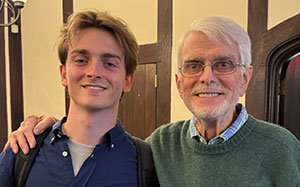
Don with his grandson Charlie
at the Yale ’64 Class Council meeting
on February 14, 2026
Don Edwards was a member of the 1964 Class Council, at least since 2004 when I was named Class Secretary. His death leaves a gaping hole on the Council and in the Class. Don was always a voice of calm and kindness in our Council debates. At our most recent Class Council meeting in February 2026, Don was over the moon to watch his grandson, Charlie, give a presentation about his work as our 1964 URI intern last summer. It was as if things had come full circle.
Among many other contributions, Don founded our Class Support Group and guided classmates in their support of fellow classmates. He also served a term as our YAA Delegate.
In 2022 he was happy to report that the third Edwards generation was attending Yale. His beloved wife Sally preceded him in death in 2022. Don will always stay alive in our 1964 Class memory.
Note from Jack Gillette ’85 Ph.D. to his brother, our classmate Howard Gillette ’64
by Jack Gillette
May 2, 2026
Howard:
Here is a message to send to your classmates.
One of Don Edward's legacies is the time and skill he brought to Loaves & Fishes, a free food and clothing outreach in New Haven, Connecticut. The city has a high concentration of individuals and families that are food-insecure and don't know where their next meal is coming from.
Every Saturday morning, Loaves & Fishes offers groceries that include not just the usual canned and dried food items, but milk, eggs, meat or fish, and fresh fruit and vegetables. Shoppers can also visit our free boutique and select up to ten items of clothing. This year we estimate that we will distribute over $1,000,000 of food and clothing to the community.
Need has always been steady but the new SNAP regulations have pushed our weekly numbers to 500 individuals. Of these, 300 come to our location to shop while we prepare 200 bags for delivery to those who cannot come out and shop, including the elderly, the infirm, and those afraid to leave their homes. Our deliveries are a vital lifeline.
Don initially came as a volunteer, joining a small army of volunteers who move three and a half tons of food and hundreds of pieces of clothing every week to create a grocery and clothes store where our neighbors can select items they need.
He then lent his expertise in guiding the Board of Directors toward an active and effective role, serving as President until his illness forced him into an emeritus role. He remained engaged until a few weeks before his death. His knowledge and support will be deeply missed.
Don's efforts, along with so many volunteers, kept our overhead low and our impact high. For every dollar we raise, four dollars in food and clothing value goes into our community.
We depend on fund raising and this May is one of our biggest events. It is a city-wide effort organized by the Greater New Haven Community Foundation to raise awareness of the needs of the nonprofit sector in New Haven.
This year our goal is $50,000. One of Don's last acts was to pledge $5,000 as a matching grant, bringing our matching total to $25,000. This match doubles the impact of your gift and with our four-to-one added value a $100 gift becomes a $200 gift becomes an $800 gift to our community.
So please give by clicking this link. The site is open and closes on Friday, May 8, 2026.
If you want to write a check, make it out to “Loaves & Fishes” and mail to 57 Olive Street, New Haven, CT 06511. Write “Great Give” in the memo line.
Know you can honor Don and make a difference right away by helping us serve our community for many Saturdays to come.
Best
Jack
Essay, 60th Reunion Book
by Don Edwards
May 2024
In the spring of our senior year, my Stiles neighbor Kai Lassen arranged a blind date for me for the senior prom. Sally Barnard was a Wellesley graduate doing a master’s degree at Yale. By the end of the summer, we were engaged. By the end of the year, we were married. Our whirlwind romance lasted almost 58 years.
In the fall of 2020, Sally had esophageal surgery for reflux problems. A postoperative CT scan came back with an “incidental finding” — Stage 4 non-small-cell lung cancer that had metastasized to her liver, lymph nodes, and spine. Although she was symptom free, there was no hope of cure. But the genetic mutation that caused her cancer could be treated with a daily pill — without chemotherapy.
As a former hospital and hospice chaplain whose thesis for her second master’s degree was on “Spiritual Care for Cancer Patients,” Sally was encouraged to write a memoir of her experience. She had thought and prayed about the choice between length of life and quality of life since her first advanced directive thirty years ago. She wanted to describe that choice, not as a seminary student or as a hospice chaplain, but as a patient with a terminal disease. As the cancer inexorably reached the lining of her brain in the spring of 2022, she was unable to finish. I wrote an epilogue about the end of her story.
By early August her cognitive decline had become obvious. An MRI confirmed a diagnosis of leptomeningeal disease with a life expectancy of three to six months. With the help of Connecticut Hospice and private aides, and with unstinting support from our daughter and son-in-law, I was able to care for her at home. At the end of September I was at her side when she died peacefully. Thanks to hospice medications, she was not in serious pain.
We celebrated her life with a memorial choral eucharist at St. Thomas’s in New Haven. In the “Prayers of the People” I wrote for the service, we recalled the ways Sally’s life reminded us to be grateful:
For rocky coasts and fog, for seagulls and baby ducklings, for tidal pools and glorious sunsets, Gracious God, we give you thanks.
For flowers to plant and weeds to pull, for trees to prune and birds to feed, for all the wonders of Creation, Gracious God, we give you thanks.
For artists and poets, for composers and musicians, for dancers and choreographers, for flower arrangers and needleworkers, and for all who give us glimpses of heavenly beauty, Gracious God, we give you thanks.
For opportunities to learn and teach and for the lasting bonds they create, Gracious God, we give you thanks.
For churches that welcome the faithful, the seekers, and the doubters alike, Gracious God, we give you thanks.
For organizations that work to fight racism, hunger, and disease, and for people of all faiths and of no faith who do justice, love kindness, and walk humbly, Gracious God, we give you thanks.
For nurses, doctors, chaplains, technicians, and aides who care for the sick and dying, Gracious God, we give you thanks.
For good food and wine and guests to share them with, Gracious God, we give you thanks.
For the excitement of surprising family, friends, and strangers with unexpected gifts and celebrations, Gracious God, we give you thanks.
For the passion and joy of married love, and the freedom to marry whom we choose and plan the families we can support, Gracious God, we give you thanks.
For loving mothers and fathers, for families of all kinds, and especially for grandchildren, Gracious God, we give you thanks.
For Sally’s life and work and love that have enriched all of us who mourn her loss, Gracious God, we give you thanks.
For the communion of saints who sustained her in life and who surround her now, Gracious God, we give you thanks.
Gracious God, we pray to you for Sally, and for all those whom we love but see no longer. Grant to them eternal rest. Let light perpetual shine upon them. May her soul and the souls of all the departed, through the mercy of God, rest in peace.
Amen.
Essay, 50th Reunion Book
by Don Edwards
May 2014
My childhood in Tulsa provided me with a wealth of advantages: a loving family, excellent public schools, and cultural opportunities. It also gave me an unforeseen advantage in getting into Yale: I was, to paraphrase Stephen Carter, a “geographic distribution baby.” Growing up, I never thought about going to the Ivy League. My closest friend and I applied to the Big Three pretty much on a lark. He got into Harvard; I got into Yale and Princeton. I chose Yale sight unseen. New Haven seemed more “real world” than Princeton (where I had spent a summer). Living near Princeton for 49 years has confirmed that judgment. And I was drawn to Yale by the music. Singing in the Will Rogers High School glee club earned little respect. A college with a fight song written by Cole Porter was the stuff of dreams. That judgment was confirmed the first time I donned white tie and tails for a Yale Glee Club performance.
At every turn in my career, my Yale experience had an impact. The Glee Club, Battell Choir, and Alley Cats strengthened a love of good choral music that has been my lifelong avocation and late in life the basis of a second career as President of the American Boychoir School. The Board Chairman who hired me was a Boychoir classmate of my Yale Apollo Glee Club conductor. My relationship with Bill Coffin as a Battell Deacon led me to organizing sit-ins in Tulsa in the summer of 1963 and to a Dwight Hall internship with Community Progress, Inc. In my first job, with the NJ Office of Economic Opportunity, those experiences made me a credible “poverty warrior.” Two years later, I was hired by the founding dean of Livingston College, a new urban-oriented, multi-racial college at Rutgers; he was a Yale Ph.D. Thus began a 29-year Rutgers career, mostly as VP for Public Affairs. In retirement, it was a Yale Divinity alumna who persuaded me to become a Warden of my Episcopal church.
By far, Yale’s biggest blessing on my life was introducing me to Sara Williams Barnard (Wellesley ’63, Yale MAT ’64), my blind date for the Senior Prom. Next year, we will celebrate our 50th anniversary as partners and lovers. Little did I realize on that blind date that I would marry into seemingly endless Yale connections. Sally’s father and grandfathers were Yalies; a couple of ancestors were Yale presidents. Subsequently, both our children joined the parade: Jenny ’89 and David ’93. David surpassed my singing achievements by becoming a Whiffenpoof. Jenny worked in Admissions for five years before joining the AYA staff, where she’s now Deputy Executive Director. That’s where she met her husband-to-be, Ricardo Chavira (MA ‘95). Because of Jenny, I became an AYA Assembly Delegate and a member of our Class Council and Reunion Committee. For the last three years, Sally has been teaching part-time in the Yale Bioethics Institute.
Perhaps there is more to come. We have not yet “bid old Yale farewell.”
Essay, 25th Reunion Book
by Don Edwards
May 1989
Well, you asked. After 2½ years with only occasional contacts with classmates, it seems presumptuous to think anyone would be interested in my observations. But at our tenth and fifteenth reunions, I had a lot of fun comparing notes even with people I barely knew while at Yale. So herewith some brief autobiographical reflections.
I left Yale in 1964 with the same career objective I had when I entered: the parish ministry in the Presbyterian Church. A year later, I left Princeton Seminary and abandoned the ministry as a career. For twelve years, I never went to church. Yet today I am up to my ears as a lay leader in the Episcopal Church we joined in 1977, and I am at long last satisfied that I made the right choice back in 1965, though not necessarily for the right reasons. Had I become a "professional Christian," I doubt that I would have learned nearly as much about myself and the world of politics, economics, and bureaucracy in which most of us work. And I suspect I would have avoided (or tried to avoid) the challenges that have forced me to grow and to try to make sense — theologically and otherwise — out of the rather ordinary life I live in a very secular world.
Six months after graduation I married the woman who was my blind date for the senior prom (thanks, again, to Kai Lassen). It was the best decision I've made in my life, but I saw it then, and continue to see it, more as a gift than as a decision. Sally said she wanted to see who I would turn out to be in twenty years; fortunately, when the twenty years was up she was still interested. As each of us has changed, our relationship has changed, and the changes have not been easy. But our conviction that a lifelong commitment is worth the effort is even deeper now than when we wed in 1964. We formally renewed our vows on our twentieth anniversary!
Graduate of Walnut Hill, Wellesley, and Yale ('64 M.A.T.), daughter of a Yale man, granddaughter of two more, resident of Guilford with a summer cottage on the Maine coast, Sara Williams Barnard was to me the quintessential Eastern girl. She thought I was an Oklahoma millionaire. I quickly learned that her Establishment credentials were of little consequence to her (although the summer cottage was real and has come to play a key role in the development of our family). She found out that my oil money was limited to my father's salary from what was then the Humble Oil Company. We have become, after a fair amount of struggle over 24 years, lovers, friends, parents, colleagues, and partners — though not necessarily in that order.
The second great gift in my life is a consequence of the first. Our children — Jenny, 21, Yale Class of 1989, and David, 18, a senior at Princeton High School — have been a source of wonder and blessing from the very beginning (I was in the delivery room for David's birth). Rearing children is no less a struggle than building a marriage, and we have managed to pass on to them too large a portion of our achievement compulsions. They have, however, survived this and other parental inadequacies to become bright, attractive, talented, compassionate people. Now as our parental roles begin to wane, they are increasingly friends and colleagues whose company we seek whenever their busy lives allow.
I'm still trying to decide what to do when I grow up. I was recruited to Rutgers as an Assistant Dean in 1968 from a job in the New Jersey anti-poverty program. By 1976, at the age of 34, I was the youngest vice president ever of the eighth oldest and sixteenth largest university in America. Twelve years later, I am still a vice president (no longer the youngest), and our classmate, Jim Duderstadt, is President of the University of Michigan. And unlike our classmate, Gus Speth, I am not mentioned repeatedly on "Washington Week in Review" (although I am quoted regularly in the New Jersey and New York media). Yale still has this way of making us feel, even as alumni, that we are big fish in small ponds. The difference now is that I don't care as much. My small pond is a very rewarding one, and most of the people I've known who were driven by the need to achieve fame, fortune, or power have paid a heavy price, as have their families. I have enough trouble keeping my modest achievements from becoming the basis on which I measure my human worth.
I came to Rutgers, The State University of New Jersey, twenty years ago, first to help found a new college with an explicitly multi-racial mission, then to serve as executive assistant to a new president. As Vice President for Public Affairs and Development, I'm responsible for Rutgers' relations with the citizens of New Jersey, government and corporate leaders, the media, and its almost 200,000 alumni. I supervise the departments of the university communications, alumni relations, government relations, community affairs, and the Rutgers University Foundation, which is conducting a $125 million Campaign for Rutgers (we're at $105 million with two years left). Most of the time it's a wonderful job, and I love doing it. A great state university can make an enormous contribution to the economy, the culture, and the quality of life in the region it serves, and that's what we're trying to do.