


In Memoriam

George M. Hampton, Jr.
George Hampton passed away on January 21, 2009. Here are his obituary and remembrances by two classmates.
- Obituary, The Star-Ledger
- Remembrance by Pat Caviness ’64
- Remembrance by Dick duPont ’64
Obituary
The Star-Ledger (Newark, NJ)
January 25, 2009
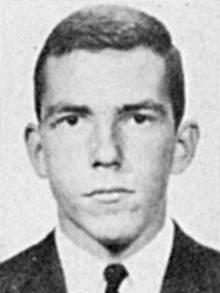
George Hampton
1964 Yale graduation
George M. Hampton Jr., 67, of Millburn NJ, passed away on Jan. 21, 2009. A memorial service will be held at the Elizabeth Rodman Voorhees Chapel, Douglass College, New Brunswick, on Saturday, Jan. 31, at noon.
Born in Parkersburg, W. Va., George spent his childhood and youth in Little Rock, Ark. He graduated from the Taft School in Watertown, Conn., where he was head monitor and then continued on to Yale College.
After college, he served his country in the U.S. Army, and was stationed in Korea and discharged with the rank of sergeant. George started his 25-year career with SeaLand Services in Seattle, Wash. He traveled the world in his corporate career, living and working in New Jersey, the Netherlands, Spain, Dubai and Hong Kong. George was honored by being inducted into the inaugural “SeaLand Masters Class.”
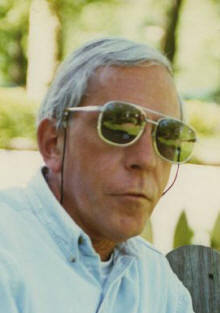
George Hampton
in later life
Upon his retirement, he became actively engaged with the Taft School, serving as class agent. He was the recipient of the Chairman of the Board of Trustees award for eight consecutive years.
George was predeceased by his parents, George M. and Elizabeth Brooks Hampton of Little Rock, and by his daughter, Katherine Kelly Hampton. He is survived by his wife, Sheila Kelly Hampton; grandson, Devon Hampton; also surviving are Thomas and Mary Kelly McLaughlin, Maggie, Maeve and Jack McLaughlin.
George donated his remains to the Robert Wood Johnson University Hospital in New Brunswick. Memorial contributions may be made to the Taft School, Watertown, Conn. 06795, or to the Associate Alumnae of Douglass College, 181 Ryders Lane, New Brunswick, NJ.
Memorial Service, Battell Chapel
written by Pat Caviness '64, read by John More, '64
June 5, 2009
[This memorial service took place during the 45th Reunion of the Yale Class of 1964.]
George Minor Hampton, Jr., 67, Yale Class of 1964, passed away on January 21, 2009. George had long battled lung cancer without complaint, persevering and defying medical predictions for a number of years.
Bom in Parkersburg, West Virginia, in 1941, George spent his childhood and youth in Little Rock, Arkansas. His father, George M. Hampton and his mother, Elizabeth Brooks Hampton, were active in Little Rock affairs for many years.
After attending elementary and junior high school in Little Rock, George arrived at Taft School in Watertown CT in mid-September, 1956. He told friends, "I had a clear recollection of riding in the bus from the Waterbury train station up to the school sitting across the rear wheel seats — just a boy from Little Rock who had never ridden in the back of a bus nor seen so many tweedy boys. 50 years later, I am fortunate to say I regard my fellow students as lifelong friends".
By the time George was a senior he had gained the respect and admiration of his classmates and was selected the school's head monitor. The head monitor position in a prep school is the equivalent of the president of the student body in a public high school. In an all-boys school the position carried with it considerable prestige, influence and responsibility. Many times as head monitor, George would address the students and faculty at its nightly assemblies. Throughout the year, as student leader, he conducted regular meetings with the other selected senior monitors dealing with student activities and conduct.
George was not a natural athlete of imposing stature but made up for it with determination, grit, and a hardnosed attitude. Though undersized, he played guard. He liked to mix it up in the line. He would frequently come back to the Taft huddle with his oversized helmet strangely askew on his head and his face bruised. You knew he had been hammered by some much larger opposing lineman, but you also knew the fight was still there, his spirit unbroken. "Let's go," he'd say and he meant it.
George's father, a well respected businessman in Little Rock, had graduated from Yale. It was no surprise and with pride that George was admitted to Yale. After his sophomore year, he took a year off and returned to Yale to graduate in 1966 with a degree in political science.
Upon graduation and after opting out of an Officer's Training Program because it involved a four-year commitment, George was drafted immediately. He joined the U.S. Army as a private and was stationed in Korea. Through a series of promotions he made sergeant. George once told me a story about his duties as a sergeant during a bitterly cold winter in Korea. He would take his men out in the snowy mountains on weekly maneuvers. Frostbite was a big crippler because the men wouldn't take care of their feet. He taught them to change their socks frequently and would call regular halts during their patrols to give his men time to change. "No one in my unit ever had to leave the field due to frostbite," he told me proudly.
Leaving the service in 1967, George joined SeaLand Services, where he worked for the next 25 years. SeaLand Services is a large integrated state-of-the-art containerization shipping company. George traveled the world in his corporate career, living and working in the Netherlands, Spain, Dubai, and Hong Kong. Moving from one port to the next, George moved successfully through SeaLand's executive ranks. On retiring, the corporation honored George by inducting him into its inaugural "SeaLand Masters Class." His last assignment was in New Jersey, where he decided to retire and live in the small community of Millburn.
George and his wife, Sheila Kelly Hampton, settled in Millburn. They lived there for the rest of his life. They had two daughters. Katharine died at age 3½. The other daughter, Elizabeth Hampton, gave birth to a son named Devon Hampton, now age 9, whom George and Shiela raised.
After retiring, George managed his own financial affairs. By all accounts, he took great pleasure in managing his portfolio until his death.
George was devoted to Taft and retained a lifelong commitment to the institution and his fellow classmates. The school defined his primary community of friends. He remained fiercely loyal to the school throughout his life. From the time of his graduation and extending over the next 35 years, George was the 1960 Taft Class Agent. He wrote a regular column in the Taft alumni magazine about the comings and goings of his classmates and maintained a close correspondence and connection to everyone in his senior class. If you wanted to know about a classmate, a quick call to George and you would be brought up to date in short order.
Every spring George mobilized for the annual Taft clas-giving campaign. He made sure every member of the class made a donation. Remarkably, George's Class of 1960 maintained almost 100% participation throughout his time as its Class Agent. For this extraordinary record, George was the recipient of the Taft Chairman of the Board of Trustees award for eight consecutive years.
George's low-keyed, modest, and understated manner projected an initial impression of a reserved demeanor. That appearance concealed a wicked wit and wry, self-deprecating sense of humor that brought quick smiles to his friends and colleagues. Most people who met George warmed to him immediately. You just wanted to spend time visiting with him because you knew he would bring up some zany observation or offbeat story that left you chuckling the rest of the day.
George possessed a humble, diligent, and resolute soul. He developed an emotional stability and conscientiousness people were drawn to and trusted. As a young man, he discovered self-knowledge at a much earlier age than his classmates. He had a deeper feel for human relationships and a greater sensitivity toward his own emotional chords than those around him.
A good listener, a good team man, a strong communicator, George had another side to him that was shy and inward-oriented. Attracted to detail, he had an admirable persistence to him. When working on a project or studying his investments he would exhibit analytic thoroughness and the ability to work long hours.
A Memorial Service was held for George in Elizabeth Rodman Voorhees Chapel, Douglass College, New Brunswick, on Saturday, January 31, 2009. A number of George's friends and classmates spoke about their love and devotion for this honorable caring man.
Sincere, wise, caring, and a great listener, George was a friend to everyone in our class and respected by all who knew him.
George has been an inspiration in his service to us all. Simply put, he was everyone's Head Monitor up to the day he died. We will never have another quite like him. George was ministerial in his genuine concern for us all. His way of being never bowled you over, it was simply exemplary.
Memorial Service, Voorhees Chapel, Rutgers
by Dick duPont ’64
January 31, 2009
I am fully convinced the soul is indestructible,
And that its activity will continue through eternity.
It is like the Sun —
Which, to our eyes, seems to set in the night;
But it has, in reality,
Only gone to diffuse its light elsewhere.
This passage is something I borrowed from Lance Odden a while back, then had the agony and the comfort of using several times — including now. It's a quote from Goethe. Lance used it for a piece in the Taft Alumni Bulletin on Lois DePolo's passing. I never knew Lois, but judging from Lance's remarks,
she'll definitely be on hand to greet George.
And speaking of greeting George, this is how we met. George wrote:
“I may be off by one or more days, but in mid-September of 1956,
I have a clear recollection of riding in the bus from the Waterbury
train station up to the [Taft] school. I was sitting across the rear wheel
seats from you and Zack — just a boy from Little Rock who had
never ridden in the back of the bus, nor had he seen two boys as
tweedy as you two. Fifty years later, I am fortunate to count both of
you as friends.”
Non Ut Sibi Ministretur Sed Ut Ministret
I first heard those words at our first Taft Vespers. I turned to my new chum beside me and whispered, "Must we have it in Latin? — For God's sake, this is the second half of the 20th century!"
It was George, so those thin straight lips of his curled back ever so slightly on one side of his mouth as he nodded — barely — and rolled his eyes back — just a bit. From Hamps, that meant, “understood.” And I did. However, none of us, including George, had a clue at the time just how fully he would come to champion our Taft motto — perhaps more so than ever before.
“Not To Be Served — But To Serve”
George has been more than inspirational in his service to all of us — from all parts of his life — gathered here today. Simply put, he was everyone's Head Monitor up to the day he died. We will never have another quite like him.
And George was ministerial in his genuine concern for us all. His way of going never bowled you over, it was just exemplary. It reminds me of that simple but telling line by Mahatma Ghandi: “We must become the change we want to see in the world.”
Let me quote from an email sent to us recently by John Tietjen — another wonderful Class Agent. "Teej" writes:
“George was truly the leader of our class and acknowledged as such by being elected as our Head Monitor. After graduation, he somehow remained our Head Monitor, keeping in touch with so many of us, showing interest in the progress and events of our lives and rarely speaking of his own.”
By way of illustration, I will read from some personal correspondence with George. I wrote to George:
“Hey, Ramps: It was great to see Sam Applegate. I never cease to wonder at how quickly and comfortably our old school relationships rekindle after long periods of dormancy. (No one knows this better than you.) We were chat-chat-chatting away and could have easily gone on all night. Sam tells me you have been further challenged by yet another health issue. What's up?”
George replied:
"Let me postpone health comments for several days, as some underlying things are in flux at the moment. When looking through your book you sent, I am always touched that you kept the photo of Zack and ourselves, and with your caption for same. Another intriguing feature of the ease of rekindling you mentioned. The latter clearly exists not only after 50-plus years, but also after that many years during which we have led different or distinct lives. Most of us seem almost consciously to have fought off the insistences of uniformity and conformity from our years in the incubator. Yet all those differences and those distinctions do not inhibit re-ignition."
Here's another quote from Teej:
“Sincere, caring, and a great listener, George was a friend to everyone in our class and respected by all who knew him.”
And here's what George taught me about respect, which I can best illustrate by reading a short passage from a letter I wrote to my youngest son, Sam, awhile back on the occasion of his completing some really tough work in a particularly impressive fashion:
Sam, you have my respect and that of your entire family. And you got it the only way possible — you earned it. And so it is with all of us. We can't say, ‘I think I'll go down to the corner store and buy a pound of respect.’ We can't even say, ‘ I think I'll go attend that meeting and win some respect.’
Respect comes to us; we do not go to it.
- It comes first from the acceptance of one's self and fellow humans.
- Then, responsibility takes root in those acceptances.
- With the assumption of responsibility comes work.
- And through good work we earn the respect of others.
- And so, the more you ignore it, the more respect comes to visit,
- For its validity rests with the honest work of the recipient.
- Respect usually comes when we concentrate on other things.
A few lines from "If" by Rudyard Kipling:
If you can talk with crowds and keep your virtue,
Or walk with kings — nor lose the common touch —
Or watch the things you gave your life to broken,
And stoop and build 'em up with worn-out tools —
If you can force your heart and nerve and sinew
To serve your turn long after those are gone —
Yours is the earth and everything that's in it
And — which is more — you'll be a man, my son!
(George was definitely a man.)
Let me close with two ending verses from Brian Brooke's wonderful ballad — “Under the Mists of the Kenia Snow.”
This lengthy opus is from the early colonial days in British East Africa. It culminates with a titanic battle between two buffalo bulls — father and son.
And so it ends, as life often does, with a succession of sorts — in this case with the old bull’s defeat. He is the fallen hero who leaves the scene very much in accordance with the great way of things. Of course, his spirit lives on.
Then wearily up from the sod he rose,
To face the hill of eternal snows,
And up to the cliffs and the mist he goes,
Silent, majestic, stately, and slow.
For all the he wished was a place to hide,
So upward he trudged in his lonely pride,
Then gently lay down in the snow and died
Under the mists of the Kenia snow.
The white men who know this perhaps are few,
'Tis only of late that the white man knew.
But the fact remains that my story's true.
You can go and see if you want to know — Climb
up on the cliffs till the snow and sky
Appear as one with the peaks on high,
And there in his pride doth the old bull lie,
Safe in the silence of Kenia's snow.