


In Memoriam

J. Charles Mokriski
Chuck Mokriski ’64 passed away on December 20, 2025 in New York City. Below are the following remembrances:
- Obituary, The Hartford Courant
- Essay, 50th Reunion Book
- Essay, 25th Reunion Book
- Interview by Howard Gillette ’64
Obituary
The Hartford Courant
January 11, 2026
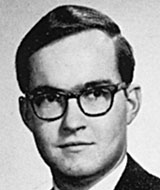
Chuck Mokriski
1964 Yale graduation
John Charles Mokriski, known to his friends as Charles or Chuck, died at the age of 83 in New York City on December 20th, with his son Charlie present at his passing. Charles spent the last two years living in memory care in Manhattan, where he received excellent care and was beloved by the caregivers and staff. Charles is survived by his brother James and sister Rochelle, his children Emmy Vickers (Richard), Sarah Barry (Paul), Becca LeCompte (Anthony), Charlie Mokriski, and David Mokriski (Thainá), and his grandchildren Kayla Kempskie (Dylan), Christopher Barry, and Ozzie LeCompte.
Charles was born in 1942 in East Hartford, CT, to Lillian and Frederick, and grew up in public housing with his older sister Rochelle and younger brother James. He often spoke of picking raspberries for five cents a basket on a nearby farm.

Chuck Mokriski
in recent years
Charles attended East Hartford High School, where he won his first Academic Award for Excellence in Algebra as a freshman, then transferred to Enfield High School, from which he graduated as Valedictorian. He excelled as a center fielder on the Hazardville Powder Kegs, which competed in the Babe Ruth League.
Charles attended Yale University on a full scholarship. Yale deeply influenced Charles. He was proudly active in St. Thomas More House, a Catholic organization on campus with which he remained active throughout his life, including as a board member. Charles was selected to join Yale’s chapter of the Phi Beta Kappa Honor Society in his junior year. Senior year brought an invitation to join Book and Snake, one of Yale’s secret societies.
Upon graduating, Charles received a grant from Yale to travel to Europe for the summer, an experience that turned him into a lifelong “Francophile.” If Yale was his second home, France became his third. Among his great joys throughout his life was planning trips with family and friends in and around France.
He went back to school to pursue a PhD in history until, in 1968, the assassinations of Martin Luther King, Jr. and Robert F. Kennedy inspired him to change fields to law. Father Robert Drinan, S.J., then the dean at Boston College Law School, encouraged him on this path. He graduated from Yale Law School in 1971.
Charles so deeply appreciated the opportunities that his alma mater gave him that he created a permanent scholarship for an undergraduate student in the name of his own father, J. Frederick Mokriski. He never forgot that his father dropped out of school after eighth grade to support his siblings and was never able to attend college. This history informed Charles’ lifelong devotion to stewardship.
Charles began his career in Connecticut as an attorney and lobbyist. In this work, he always kept his values in mind, for example, by turning down lobbying work from the tobacco companies. Charles also served for a time as the Chair of the Hartford Housing Authority, drawing on his own experience growing up in public housing.
Charles met Emily Nugent (Carrier), a Yale graduate student, in 1962. They married in 1965 and raised three children together, Emmy, Sarah, and Becca. While building their family and careers, Charles and Emily traveled annually throughout Europe, and Charles also found time to perform with the West End Players in Hartford.
Some years later, Charles was introduced to Laurie Padolf, a veterinarian, on the basis of their shared interest in Europe, and they married in 1986. With Laurie, Charles raised his sons, Charlie and David, living first in Glastonbury, CT, then moving to Massachusetts, first Boston and then Newton. With Laurie and their sons, Charles continued to travel, as well as coach his sons’ soccer teams, teach Sunday School, and serve as a lector at Our Lady’s Help of Christians parish in Newton.
Charles spent 39 years with the Hartford firm Day, Berry, and Howard, later Day Pitney, as a litigator in cases involving commercial law, intellectual property, media access, and defamation. In 2010, Charles joined Proskauer Rose, working as Professional Responsibility Counsel and as a member of the Law Firm Practice Group, often representing lawyers in matters of legal ethics and professional responsibility.
As legal ethics became the principal focus of his practice, he was recognized in the profession and by his peers as a leader. He served for many years as a member of the American Bar Association’s Standing Committee on Ethics and Professional Responsibility, a member of the Massachusetts Board of Bar Overseers, president of the Association of Professional Responsibility Lawyers, and chair of the Boston Bar Association Ethics Committee. Charles taught legal ethics at Boston College Law School and chaired numerous continuing legal education panels. He was a prolific writer, frequently penning essays on politics, law, as well on the Catholic Church.
And he took great pleasure in writing about food. His long-running gig as a restaurant critic began in Hartford after he pitched his writing of restaurant reviews to the editor of the Hartford Courant, which continued in Boston with reviews for the Improper Bostonian. Charles always had a love for cuisine, cooking, and entertaining.
In 2012, Charles moved to the Kips Bay neighborhood in New York City. He became a member of the National Arts Club, held season tickets to the Metropolitan Opera, and was a supporter of and frequent visitor to the Frick Museum. He loved New York, especially when hosting his family and friends, taking them to restaurants, museums, and the opera.
A celebration of Charles’ life will be held at a future date. In lieu of flowers, memorial donations may be made to St. Thomas More House at Yale University and the Cure Alzheimer’s Fund.
Essay, 50th Reunion Book
by Chuck Mokriski
May 2014
The first half of 1968 was a tumultuous year of assassination, urban violence, pervasive racism, and a draining, tragic, and probably illegal war. One day I confessed the depth of my dismay to Yale History Professor Jack Hexter, under whom I studied Tudor and Stuart England. He assured me that the rule of law in our country, with its English roots, was resilient enough to survive the then current turmoil. Later, the news of the assassination of Robert F. Kennedy, former chief legal officer of the country, staggered me, and, with Hexter’s paean to the law still on my mind, I impulsively decided to quit academia and go to law school. I’ve never looked back.
My Yale J.D. came in 1971, followed by 39 years in one law firm (20 in Hartford, 20 in Boston), with a practice ranging from divorce lawyer to lobbyist to media lawyer to intellectual property and commercial litigator, to ethics counselor. Along the way, I threw myself into community theater and the Connecticut Opera board, served as chair of the Hartford Housing Authority, the due-process tribunal of the Archdiocese of Hartford, and the Boston Bar Association Ethics Committee. As President of the Association of Professional Responsibility Lawyers (APRL), I chaired its 2008 meeting in Amsterdam, its 20th Anniversary Meeting in New Orleans in 2010 (successfully recruiting, with the help of Paul Ruden, Book & Snake Brother Bob Woodward to deliver a masterful keynote address), and APRL’s 2012 meeting in Istanbul. I spent 35 years as a Trustee of Yale’s Saint Thomas More House, spent a decade as adjunct professor of legal ethics at Boston College Law School, wrote almost 600 restaurant reviews published in newspapers and magazines, and sounded off in dozens of OpEd pieces on political, theological, legal, ethical, and other philosophical topics.
In 2010, rather than retire I joined Proskauer Rose, LLP, as professional responsibility counsel. I have been happy and fulfilled in my work but unhappy at my dismal domestic record, failing at my 26-year marriage just as I had failed at my 18-year marriage 31 years ago, and at my four-year intervening relationship 27 years ago. Five great children and so far three grandchildren of budding greatness are the bounty of my ultimately failed marriages. Extensive travel and exposure to foreign cultures and the infinite variety and wonders of our world have enriched my life, as have my family, friends, and colleagues.
While the resilience of American law, in which Professor Hexter had such faith, got us through the 20th Century, I’m less sanguine about getting through much of the 21st. The appalling depths to which public and private ethics have fallen; the rampant and rabid racism and hatred that pollute our culture; the degree of imbecility and insanity of a critical mass of voters and office holders; the poisonous power of massive amounts of anonymous money being poured into the political process; and the cynical mockery of the rule of law made by those who should be its champions leave me even more pessimistic than I was in 1968.
Essay, 25th Reunion Book
LITTLE PUFFS OF SMOKE
by Chuck Mokriski
May 1989
[Editor's note: The following article is reprinted from The Hartford Courant, March 4, 1981.]
B-52 bomber pilots in Vietnam, and those who dispatched them, never meant to harm women and children by their actions. All they saw, as an acute commentator of the time remarked, were little puffs of smoke.
Similarly, the new policy makers in Washington do not intend to bring anguish into the lives of the poor, the helpless, or the economically marginal. Their call for deep budget cuts in social programs like food stamps, Medicaid, or urban block grants represent an understandable effort to bring the federal budget under control. President Reagan is a decent man, who would no more look a poor father in the eye and tell him that his handicapped son can no longer receive gross motor coordination therapy because the entitlement to those services has been reduced or eliminated from the Title XIX program.
Neither he nor most of his allies could listen indifferently to the cries of hungry children and coldly inform their mother that she can no longer obtain food stamps since her cleaning woman's pay puts her over the reduced threshold of eligibility.
Nor could these leaders face an elderly couple in Asylum Hill or the South End and tell them that they will have to spend food and fuel money on escalated property taxes because the city's budget has fallen apart due to the sudden withdrawal of urban block grant aid. Surely these very human consequences are far from the minds of our president and his advisers as they put their programs in place.
But the basic tenets of Western law and personal morality both hold that we do, in fact, intend the direct and foreseeable consequences of our actions. It avails little a speeding, reckless motorist to say that he intended no harm to an innocent pedestrian when he lost control of his car, hopped a curb, and crippled someone for life. But since that was a direct and foreseeable result of his speeding and recklessness, he is legally responsible and morally culpable for having caused that outcome.
The direct and foreseeable result of deep cutbacks in appropriations for economic assistance to the poor and helpless and in aid to localities designed to keep the local property tax burden on the poor and elderly at a minimum, will be not only economic hardship but acute deprivation in the basic necessities of human life. National and state leaders who impose, foster, or collaborate in these cutbacks are morally and personally responsible for the suffering they will inevitably entail.
Such cutbacks, along with major allocation of resources from butter to guns favored by the national administration, may look morally neutral on paper, as an essential term in the tidy theoretical construct of "supply side" economics. But their direct, inexorable impact on the lives of those who cannot compete in the arena of such economics cannot be escaped or ignored.
Of course, it is the hard-pressed Medicaid administrators, food-stamp supervisors, and social workers at the state and local level who must bring to the poor, the elderly, and the helpless the bad news of reduced aid and eliminated programs. It is these "faceless bureaucrats" who will have to confront the fear, the suffering, the hunger, the pain, and the despair.
In contrast, for many national policymakers, the results of their decisions are just so many documents and dry statistics, as distant as those little puffs of smoke.
Interview by Howard Gillette ’64
February 17, 2026
On November 22, 2011, Howard interviewed Chuck Mokriski in preparation for Howard’s book Class Divide: Yale '64 and the Conflicted Legacy of the Sixties. Howard has deleted some personal details from the interview that Chuck may not have wanted to share, but the account of Chuck’s transition to adulthood is very much a part of the story that Howard was trying to tell.
Here is the interview, in Chuck’s words.
I was the middle child of three children, a Polish-American father, who was first-generation American. His father and mother had come over from Poland from the Galetzia area, which is near Crackaw. My mother was born in Maine, but she was really of Canadian extraction, from New Brunswick, and was primarily French in heritage. She didn’t admit to it, because living in New Brunswick her English name was worth lots. The French were really dumped on in New Brunswick. They were working-class people. My dad worked at United Aircraft, Pratt-Whitney Aircraft in one of the dirtiest jobs. It probably gave him cancer, from which he died at age 62. He was on the plating line, electro-plating parts for aircraft engines. He was a smart guy, but he never went to high school because he was the oldest of five kids and had to go to work at 12 years old to support the family, which was on life support. I think it was a big regret for him, all his life, because he had a very inquiring mind. He instinctively reached for the dictionary when we collectively came across a word he didn’t know. But he was a very good student. In fact, he showed me his report cards. I got very good grades, as all of us did, and some of us even through Yale. His grades from school were red A’s and red A’s meant 100, which persisted all the way through his formal schooling. My mom went to a small high school with nine people in her graduating class. She trained to be a nurse, but never worked as a nurse. She came down to Hartford because of jobs, where she met my father. They got married, in the sacracy of St. Patrick’s Cathedral because they only knew each other a few weeks. None of the established parishes where they lived would marry them because they didn’t have a track record.
In that either auspicious or inauspicious beginning, they had three children. My sister is five years older, the first person in my extended family (mother’s and father’s siblings) to go to college. She went to UConn. She was an example of women’s lib and a liberal person as I got to know her better intellectually. She was tracked in the commercial course in high school to become a secretary. She got interested in going to college, did so, and taught school and had four kids. ...
My five children come from two marriages. I married a women I had met in conjunction with St. Thomas More House. She was at Smith College, and we were married for 18 years. We had three children, two biological daughters and an adopted daughter. We came to adopt our daughter when our biological daughter was about six months old because Emily, my wife at that time, was teaching school, working at Yale-New Haven hospital with bedridden kids. One day she came home and said, there’s this little girl, all by herself. Her parents have taken it on the lamb. She has a kidney disease and only one kidney. She’s stable and doing well. Why don’t we take her in? She was four years old. And I said, well, you better put your money where your mouth is, you’re pro-life, you’re anti-abortion. This is a child who is surplus goods of a society, and we took her in. She thrived in our care. She’s 49-years old now, living in Silver Spring, Md with her husband whom she met at Howard University. She’s Afro-Caribbean by background. ...
I ran into my first serious racism with Emmy. As I said, she was Afro-Caribbean, dark complexion. We had been living in Florence-Virtue homes in New Haven in 1968, a pretty tumultuous year. New Haven had some serious riots. We had about four burglaries in about two weeks. This was the time when people were complaining about crime in the streets. Crime in the streets, I said, that’s where it belongs. Get it out of my fucking living room. So we moved to the suburbs and achieved some physical security, but at a cost that was almost unbearable. One day, Emmy and I were watching the Al Jolson story on television, and she said, “Daddy, why has that man got black on his face?” I said, this is an old form of performance called a minstrel. He’s put the black on his face so he can appear to be a Negro. She said, “Negro, is that anything like nigger?” I said, Emmy where did you hear a word like that? “That’s what the kids call me on the school bus.” It was just devastating, we had subjected this kid. Because Florence-Virtue homes was 50/50, totally integrated in New Haven, off of Goff Street on Whalley Avenue, close in to the campus. So, I had a new project, Project Concern had just been developed in Connecticut to bus inner city kids to suburbs, as a voluntary program that towns could join. I lobbied some people I had gotten to know in Cheshire, a nice town, which had a sign when you drove in from Hamden on Rt. 10, “Cheshire: A Nice Town,” which was ironic considering what we ran into. There were several lawyers on the board of education, and they were somewhat instrumental in persuading me that all lawyers were not evil money grubbers because they supported Project Concern. There was a public hearing, and I made sure I was the first person there and got my name on the speakers list before anyone else. I can’t remember exactly what I said, but I do remember ending my remarks by saying, “You know, this project is something this town needs, not the kids who are coming up here, but this town.” I described the incidents we had the neighbor, not just the school bus incident because I wasn’t there. One of the neighbors, Emmy had gotten into an argument with her daughter about the same age, who grabbled her and shook her and said, “They ought to send all you niggers back to Africa.” The town approved the program. At that point she was about 6.
During this period, the tumultuous 1960’s, I ran into Jack Hexter of the history department. I was very disturbed about the country. We were waging a war in violation of international law. We had racial discord and tumult and conflict in the country. I said, this country is disintegrating. Hexter said, no, don’t worry, we have a very firm tradition of the law, laws are part of our culture. I have faith that they are resilient enough to withstand the pressures from the things that are happening here. Well, not too long after that, about two months, that was after MLK was assassinated. Bobby Kennedy was assassinated on June 5, 1968. I know the date, because it was that date when I sat down with Helen and said, Helen, I can’t stay in grad school. I was writing my dissertation. My orals were behind me. I’ve got to go to law school. I said, Kennedy was a lawyer. It’s law that was at stake in this country. We are a country, if I can believe my mentor Jack Hexter, that respects the law and that it is deeply embedded in the fabric of our life. So I’m going to law school.
I was naive enough, so I went to the Yale Law School — this was mid-June, 1968 — and said, I’m here. I’d like to come to your law school. They said, wait a minute. You haven’t taken the LSAT’s, we’re oversubscribed. We admitted 200, hoping to get 150 and got almost 200. We don’t have any room for you. So I went to UConn law school. They said no too. Decided to go up to see Father (Robert) Drinan at Boston College Law School, he was the dean at the time. He didn’t know me from Adam, but I walked in. I showed him my resume and what I had done. He said, we’d love to have you and shook my hand. I looked at moving up there. The costs were horrendous. Boston had a much higher living cost. I was despairing. We had nil funds. My wife wasn’t working. We had two children, one foster child, so I went back to UConn and said, you sure you guys won’t bend the rules a bit. You’re considerably down the food chain from B.C. — I didn’t say it that way. But it was a pretty respected law school, so they let me in, so I went to UConn for a year and won all their prizes. Then, like an ingrate, Arthur Saxe at the law firm where I worked for the summer (he a partner with Bob Giamo) liked the cut of my jib, leaned on me and said you really ought to be at Yale Law School. So I applied and they took me in as a transfer student. So I spent two years there, starting in 1969.
The law school then was in great turmoil. We had a lot of very outspoken students. Nancy Gertner, a classmate of mine, has written a book about the period. (In Defense of Women: Memoirs of an Unrepentant Advocate, April, 2011.) A speaker at our graduation claimed what a terrible, racist place it was. There were some students brought up on charges for physically threatening a professor, and there was a great deal of dialogue in the liberal community, about, well, this is understandable, you have to take these threats in context. I’ve been the target of black racism as well as the target of white racism towards my family. I’m an equal-opportunity detractor of racists.
I go to Yale Law School, I accept an internship at Sullivan and Cromwell on Wall Street between my second and third year. Obviously I was not as imbued with changing the world at that point, as it was a nice piece of change, for the summer, and they offered me a job. But my then wife wouldn’t dream of moving to New York, so I accepted a job in Philadelphia. That was my compromise. I wanted to get to a city, Dechert, Price, and Rhodes. Then, my Dad was diagnosed with cancer the previous fall and was given six months to live. He was a tough, wiry Polak, and he hung on, but he needed help in Hartford. So I took a temporary job at Dayberry and Hubbard in 1971. The offer was only for the summer because they were oversubscribed. I’m the longest-living summer associate at Dayberry and Hubbard. I like to think I went directly from summer associate to partner eight years later.
I did a lot of non-mercenary things in that period. I was active in the arts. I was also chair of the Hartford Housing Authority, which was a real education for me. Four years I was chair. I quit over being assailed as a racist for not selecting an architecture firm that was just a front for an established white firm. There was just one black up front. I was attacked as a racist because I hired this young, idealistic guy, who did a good job. … I got a lot of support from the community for that decision. I said, I’ve paid my dues, I’ve given four years, working basically 15-20 hours a week. I was a hands-on commissioner. I’m sure some of the staff wasn’t unhappy to see me go. It was the only housing authority I have ever known that wasn’t in trouble. I hired the executive director, an African American, in place of a long-term Irish-American director. John Wardlaw was his name.
I grew up in public housing. It was a place that people lived to save up for a down payment to buy a house some place. … Mayberry Village was built in 1941 on what was the Cannon family farm to house the influx of people who worked at Pratt and Whitney and other defense industries in Connecticut. The upper section of mostly multiple-unit construction was built first and then the “New Village,” single and duplex units, was built. The complex was named after Doctor Mayberry, a local physician who was killed while crossing railroad tracks under Burnham Street in East Hartford. In 1956, the units were offered for sale to those people living within them. Many of these families did buy their houses and rented the other apartments to the people who continued to live there.
In the earlier days, Mayberry Village was a cohesive community, managed by the Housing Authority out of the Community Building. On the first of the month, children would be carrying envelopes to the rental office to pay the families’ monthly rent payment. The Village was a safe place and there was no fear of robbery. In most families, the father was a defense worker, often a veteran of WWII, and the mother stayed home during the day. ...
We lived there through my sophomore year in high school. Then, in a spasm of anti-socialistic public housing, the federal government sold the project. The preference went to veterans if they were multi-family units. Ours was a duplex, and although we lived there a dozen years and our neighbor had been there only two years but was a veteran — my father was not because he worked in the aircraft factory job — he got to buy the house. They raised the rent, so we bought a house up in Enfield, where they were making cheap houses. That was not a totally happy thing, though it all worked out for me. Enfield was about 30 minutes outside Hartford near the MA border; took about 30 minutes by car before construction of I-91. Polyglot population, but no African Americans. Family had a FHA-guaranteed loan. Builder of thousands of homes. We paid $12,500 for our house. I went to Enfield High School, double sessions, from the time I got up there in the spring of 1957 or 58. Double sessions were great, because I got done what was needed and then I could work in a grocery store and save money.
To support his family, father worked the third shift. I felt so sorry for that guy, to be out in the freezing cold in a February evening at 11 o’clock to start the midnight shift, where he worked that third shift the last dozen years of his life until he contracted and was diagnosed with cancer.
I won all the prizes academically there. I was a very big fish in a very small pond, a tiny quasi-polluted pond. I only applied to two schools. I filled out an application for Holy Cross, because my mother wanted me to go there, saying you can’t go to that atheist institution Yale. I never filed it because I didn’t want to blow the $35 application fee. I don’t know whether I filed the University of Connecticut application either. Those were the only three schools on my radar screen. My dad was a big fan of Yale. He never went to high school, but he rooted for Yale secretly in basketball while my sister was at UConn. I was encouraged by at least one faculty member, who encouraged me to give it a shot, and I did very well on the College Boards. That’s why when Nader took off against the College Boards, and I was a lobbyist for the Educational Testing Service before the General Assembly when he was trying to get his truth in testing bill passed, I said, you know, they’re not elitist. The College Boards in fact are a ticket to schools like Yale for kids who came from high schools like Enfield or even East Hartford. I got in and got a nice scholarship. It would have cost me more money out of pocket or out of my parents’ pocket to go to UConn. On religion, I said I am what I am. Yale’s not going to change me, maybe I can change Yale. I was an altar boy. I was serious about the religion and still am.
I used to pinch myself. I remember distinctly standing on the Old Campus, saying this is a dream. I was as happy as a pig in shit. Amazing. I enjoyed my classes from the beginning. I had a roommate I didn’t pick out because I didn’t know anyone else who was going to Yale, and he went to Lawrenceville, Colby Smith. He was a sophisticated preppie. The day I arrived he showed me his liquor collection on the top shelf of his cabinet and said help yourself. Colby was a smart kid, but I think I ruined him. We were in Brad Westerfield’s International Relations course together. We went to pick up our first hour test. Colby got his first, and he got an 85 on it. He put his arm around my shoulder and said, things will even out after a while, Chuck. Those of us from private schools have an advantage. I found mine, and it was a 97. Colby was never the same. I may have inflated the grade, but it was at least a 95. I beat him out. I didn’t gloat about it, but I felt it might have had a deleterious effect on his performance because he lapsed into television watching and partying.
I never had much relationship with roommates at Yale, because my focus was St. Thomas More House. I started there right away. I promised my mom, I’ll go to the chapel, and I’ll get involved. I signed up to serve mass. Father Healey was there, in his first year, a young idealistic priest. I met a bunch of people I gave you that story of the More House in the early years. That tells the story of me and what an influence it had on me. I ran into a group of juniors that year. Out of ten junior Phi Betta Kappas, two of the guys I met in the first More House function were junior Phil Betta Kappas and there might have been another. They were Steve Clark and Paul Robinson. There were tremendous people there. There was another guy who was a tremendous influence, who wasn’t at Yale, but he had been the director of the local chapter of the National Council for Christians and Jews, which it was called then. Now, it’s called the national conference of something and justice. They’ve kept the same acronym but changed the focus. Frank Allacolli his name was. He died in the past six months. He was a tremendous inspirational speaker. He was a frequent attender or homolist at More House. That was quite a society of similar-thinking people. Many of them I stayed in touch with. I went to the Mexican program twice. It was a combination of Catholic social teaching and liberal politics or at least liberal-sounding politics. Healey ultimately left the priesthood and became a lay therapist, and the last I knew he lived in Toronto.
More House became my social core at Yale, but the religion for me is hard-wired into my psyche. I never felt I had to go shopping for a church, though I’m pissed off at the institutional church right now for totally screwing up all over the place. If they ever beatify John Paul II, that would be a travesty. I should be a saint as much as he should be. He coddled that sexual molester from Mexico. Just horrible. He also demoralized the church and the clergy. (Best friend Ted Sole, a year ahead in Pierson, became a priest, assigned to Nassau County, was isolated psychologically and ended up getting married to a woman who had been a nun for 25 years. My belief system is just that. Both my sons are unchurched. Part of the problem is that my wife, second wife, is Jewish. She’s very supportive of religion and has brought the kids to religious instruction and stuff like that, but I can see why the Jews say that their ethnicity, their religion, travels through the woman rather than the man because I haven’t been able. … I kept the kids going to church with me until 6th grade. They were baptized. My older son has become a kind of armchair atheist. The other one is much more open. He’ll go to church with me from time to time.
At More House there was a kind of prevailing bias against lawyers. These, we thought, were money-grubbing manipulators and handmaidens of the system, and academia seemed attractive so the Carnegie (teaching) fellowship was tailor-made for me. Somebody who might have considered professional school but wouldn’t because of this bias that was shared with my compatriots. Lawyers, after all, don’t do very well in the New Testament. Fair-season scribes, putting the law ahead of human needs. So, I go to grad school, and I really like the subject matter. I loved teaching History 10. It was probably one of the best years of my life. I lived in Trumbull College. I don’t know how I got this, but I got this junior fellowship in Trumbull, which gave me free room and board. So because I had this huge Carnegie stipend, I had so much money, I bought my parents a cruise. They found in their own budget a way to go on cruises every year in the following years. My father could transport himself from being a factory worker wearing his grimy acid-stained clothes to wearing a tuxedo on a boat at night. It was very fulfilling for me to be able to do that, to somewhat change their life. Shift was reinforced by outside change, but also by belief, not theological belief, the social gospel, the worker priests, the left wing of the church, not doctrinally, socially. I was doing the Big Brother program, with a little Puerto Rican brother at St. Martin de Porres School (136 Dixwell). I spent considerable time for at least several years in things like that.
Later on, after I got out of college and was in grad school, I was active in my parish (St. Martin) council in New Haven. When I moved to Cheshire, it was St. Bridgets, and that’s where I met Tom Hackett, who was a Yale graduate, a lawyer, and one of the members of the school board that was sponsoring Project Concern. I also discovered in grad school that academics are just as competitive and capitalist as the outside world. There was nothing pure about academia. In many ways, it was more hypocritical because it aspired or claimed to be governed by higher principles and values than money-grubbing lawyers.
I was writing (my dissertation) under Sidney Ahlstrom. If I weren’t 69 years old, I would go back and try to write it, about the American Catholic Church and the American state and nation in the latter part of the 19th century, where in Europe the church is reacting against the government, in England, Germany, and Italy. ... Whereas in the United States, partially due to the influence of the Americanists Orestes Brownson and Isaac Hecker, the Paulists and Cardinal Ireland, the Archbishop of Indianapolis, developed to be a great patriot. … Patriotism was the mirror image of what was going on in Europe. It was about nationalism and religion and explore those counterpoints. I never set pen to paper, though I had all sorts of notes. I never got to know Ahlstrom well, but I did get to know Cynthia Russett. She sat on my orals and was a long-time trustee of More House.
I got asked by Nick Carbone, a political leader in Connecticut in the mid-70s who became somewhat prominent nationally because he was close to Carter. He was the Democratic political boss of CT. The housing authority had always been a difficult entity, and he was looking for someone with integrity to go on the board. This was 1975. I got a call from George Levine, a Yale graduate and superior-court judge, a good friend and a member of the class four years ahead of us, I think. He was a neighbor and may have recommended me. I was just a member the first year, then I became chairman the 2-4th years. ... I’ll never forget walking in Charter Oak Terrace, one of the more problematic of the projects. I saw a soda bottle thrown out of a second story window of one of the units, so I picked it up and I knocked on the door. A woman came to the door, so I said, ma’am, it’s not helping our problem with litter and garbage. Somebody from your house has just thrown this bottle out. She looks at me aghast, with an amazing look on her face. I said, what’s the problem. She says, look around. The whole field is littered with garbage, litter, and bottles and stuff like that. What she was saying was, this didn’t add much to it. I said, it starts with one bottle. That kind of thing. I respected the tenants. I said, you know, you people are the victims of your neighbors, when your neighbors don’t act right and do disruptive things or throw garbage, whatever. So I said, we can’t police this place. You have to police it. I remember one tenant — Nelly Coles — saying, you want us to snitch on our neighbors? I said, you’re damn right I do. If they are making this a less satisfactory place to live and destroying what you are trying to build up or maintain, that’s your obligation. That’s a little incident, but it was repeated many times over my three or four years in this operation. The housing authority really consumed me for four years. It was a question of making it work. I lobbied our congressman to get more money. HUD was both our colonial overseer and our funding source. I just worked hard to make it work. We tried to co-opt the tenants association into helping run it. ... We wanted to make sure this wasn’t simply a patronage operation, and it was not. It was a stressful period but also very fulfilling.