


In Memoriam

Timothy O. White
Tim White ’64 died on July 20, 2026. Here is his obituary followed by essays that he wrote for two reunion books.
Obituary
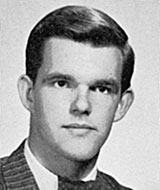
Tim White
1964 Yale graduation
Timothy Ogden White, beloved husband, father, grandfather, brother, uncle, friend, and lifelong adventurer, passed away on July 20, 2026, at the age of 83.
Born on October 2, 1942, in Chicago, Illinois, Tim lived a life defined by curiosity, optimism, and generosity. From the time he earned his pilot's license at just 17 years old, it was clear that he was never content to simply watch life unfold. He wanted to be in the cockpit, at the helm, on the ski slope, or leading the next challenge.
Tim spent his childhood in Flossmoor, Illinois, and Dickinson, Texas, before his family settled in Hinsdale, Illinois. It was there, as a junior in high school, that he met Sally Olcott, the love of his life. Their high-school romance blossomed into a marriage in 1964 that lasted 62 wonderful years. It was a partnership built on love, laughter, mutual respect, and countless adventures together.
After graduating from Hinsdale High School, Tim attended Yale University, where he was a proud member of the Yale Bachelor's, one of the university's renowned a cappella groups. Following graduation, Tim earned his MBA from the University of Chicago.
His career reflected both his inquisitive spirit and his gift for leadership. He began in marketing with Marsh & McLennan and Quaker Oats. He later joined Norlin Musical Instruments, where he led marketing efforts for the groundbreaking Moog Synthesizer, becoming personal friends with a number of cutting-edge musicians, including the members of Pink Floyd and Emerson, Lake & Palmer, as they embraced the revolutionary new instrument.
Tim eventually discovered the profession that would define much of his career: newspaper publishing. He joined Booth Newspapers in Michigan, first in marketing and later as Publisher of The Ann Arbor News. His success there led Hearst Corporation to recruit him as Publisher of the Albany Times Union before ultimately entrusting him with one of its flagship newspapers, the San Francisco Examiner.
One of Tim's greatest professional accomplishments was his ability to bring people together. He believed that organizations succeeded when everyone felt heard, respected, and united behind a common purpose. He took particular pride in building trust between management and union employees, creating an environment where collaboration replaced conflict and everyone worked toward the success of the newspaper.
Throughout his life, Tim also devoted himself to the communities in which he lived, serving on numerous civic and nonprofit boards. His leadership roles included Chairman of the Ann Arbor Area Chamber of Commerce, Chairman of the New York Newspaper Publishers Association, and Chairman of the Center for Economic Growth for New York's Capital Region. He also served organizations including Chanticleer in San Francisco, Bald Peak Colony Club, the Great Waters Music Festival in Wolfeboro, and many others.
While Tim enjoyed an accomplished career, work was never what defined him.
He was among the first to embrace new experiences. He built and flew two ultralight airplanes, and piloted his own turboprop plane, always eager for the freedom that his "magic carpet" provided. He bought one of the earliest windsurfers, one of the first jet skis, and was always ready to introduce family and friends to whatever exciting pursuit had captured his imagination.
Tim loved being outdoors. Whether playing tennis, golf, downhill skiing in Aspen or Beaver Creek, sailing, waterskiing, biking through New Hampshire, riding his motorcycle, or simply enjoying time on the water, he approached every activity with enthusiasm and joy.
His favorite places were defined not by scenery, but by the people who gathered there. Some of his happiest days were spent on the beach in Lakeside, Michigan, and at his beloved boathouse in Wolfeboro, New Hampshire. Those places became the backdrop for countless family memories, lifelong friendships, and traditions that will continue for generations. He delighted in making sure everyone felt welcome, cared for, and included. His generosity extended far beyond material things; he gave his time, encouragement, wisdom, and unwavering support to those he loved.
Tim is survived by his beloved wife, Sally Ann White (née Olcott); his son, Timothy ("Tod") White Jr. (spouse Rachel); his daughter, Melissa ("Missy") Brown (spouse Andy); his cherished grandchildren, Catherine ("Cassie") White, Alexandra ("Allie") White, and Charles ("Charlie") Brown; and his sister, Catharine White (spouse John). He was preceded in death by his parents, Philip Cleaver White and Virginia Plumb White, and his brother, Philip White Jr. (spouse Paula).
More than his accomplishments, Tim will be remembered for the way he lived and his positive outlook. He embraced change instead of fearing it. He sought out adventure rather than comfort. He believed deeply in family, friendships, and making life richer for those around him. His enthusiasm was contagious, his generosity was constant, and his example inspired countless others to dream a little bigger, live a little bolder, and reach for the skies.
A Celebration of Life will be scheduled at a later date. In lieu of flowers, donations in Tim's memory may be made to the Lake Winnipesaukee Alliance to help protect the lake he loved so deeply and ensure that its clear, healthy waters endure for generations to come. Donations may be made at www.winnipesaukee.org.
Lord Funeral Home of Wolfeboro, NH will be assisting the family with arrangements. If you wish to express a condolence or leave a fond memory, please visit www.lordfuneralhome.com.
Essay, 50th Reunion Book
by Tim White
May 2014
The summer after Hinsdale High School, I worked in a Sunbeam Appliance warehouse. I was out at three in the afternoon. I took most of the money I made and every sunny afternoon I went to our local airport to take flying lessons in an Aeronca Champ. I stood on the brakes while my instructor would climb out and spin the wooden prop by hand to start the little 65-horsepower engine. Classmates Jon Berman, Peter Beach, and George Young were with me in January 1961 when I crashed a Piper Tri Pacer into a snow covered cornfield in Vermont, on our way to blind dates at Smith. The plane was totaled, but we made our way to Rahar’s that night. The guy at Tweed New Haven Airport who rented me the plane was not amused. Flying remains a passion.
In 1964 I went to work for insurance brokerage giant Marsh & McLennan in Chicago. Sally Olcott, a high-school sweetheart, and I were married in Lakeside MI that September. Following an M.B.A. at the University of Chicago in 1967, I worked in a series of marketing-related jobs for seven years, ending up at Chicago Musical Instrument Company (Gibson guitars), where I helped acquire and develop the Moog Synthesizer.
In 1974, I began a 27-year career in newspapering, starting with Booth Newspapers, which took us briefly to Grand Rapids then to Ann Arbor in 1980. I was publisher of the Ann Arbor News 1980-90; publisher of Hearst’s Albany NY Times Union 1990-98; editor and publisher of the San Francisco Examiner and eventually the San Francisco Chronicle 1998 – 2001.
I was on the board of Mohawk Manufacturing Company in Utica, and a managing director of United Ventures LLC of Troy NY, 2000 – 2012 (when we went bankrupt). I was chair of the New York Newspaper Publishers Association, on the boards of the Albany Symphony Orchestra, Proctor’s Theatre, and the Saratoga Performing Arts Center. I was on the board of Albany International Airport and a regional HPO Capital District Physicians’ Health Plan. I was chair and co-chair of the Center for Economic Growth of Northeastern New York 1996-7. I was on the board of Chanticleer, the world’s greatest a capella ensemble, for eight years.
Today Sally and I divide our time between a Lake Winnipesaukee, NH boathouse and San Francisco, where we live on the north slope of Twin Peaks. We travel between the two in a Piper Malibu which was converted to a single engine six-seater jetprop. In addition to flying, I continue to love golf, skiing, tennis, and bridge.
Our son Tod was born while we were in Hyde Park. After high school in Ann Arbor he went to Hamilton College, spent a year working and skiing in Aspen, and then got his law degree at the University of Michigan. He and his family live in Denver, where he is founding partner of Evergreen Mergers & Acquisitions, a boutique investment bank.
Our daughter Missy Brown was born in Evanston. After high school in Ann Arbor, Missy spent her own year in Aspen, returning to get her B.A. at Northwestern University. She earned her masters in architecture at the University of Colorado. Missy and her family also live in Denver, where she has her own architectural design firm, Missy Brown Design.
Essay, 25th Reunion Book
by Tim White
May 1989
LIVING FOR TODAY: ANOTHER LEGACY OF VIE1NAM
Brief Reflections on a Quarter Century
The American tragedy of Vietnam is measured in terms of lives lost, and in terms of America's hopeless anti-Communist myopia halfway around the globe. But another tragedy of Vietnam is now being played out. America lost its long-range compass in the aftermath of Vietnam.
The Vietnam war has left in its wake an overburdened, uneven system of public education in America; a staggering national debt; and a sliding balance of trade with the rest of the world. Largely because the adults-in-charge screwed up in Vietnam, and the kids not-in-charge succeeded in pointing it out to them.
As the adults began to appreciate the enormity of their miscalculations, they had little choice but to prostrate themselves before kids' rightness on the issue. The kids of the late '60s and '70s (including some of Yale's Class of 1964) gained the high ground, but it was not to be confined to the war issue. Sensing their righteousness and political strength (and the capitulation of adults' collective guilt), kids began to set the social-political agenda which was to shape America for decades.
And what was kids' agenda in the late '60s and '70s? Beyond the current issue of Vietnam, not really much different from what kids' agendas have been for centuries: if it feels good, do it; immediate gratification; "relevance" gauged in terms of quick, tangible success; impulsive spontaneity; lack of a plan; rejection of classical values. All good, healthy stuff — when confined to kids.
Only this time, perhaps for the first time in any society in history, the adults listened. Their shame over Vietnam forced adults to listen closely to their kids — even as the topics expanded beyond the war.
The wisdom of generations, entrusted to adults, was put to the test of "immediate relevance." It was often found wanting. At one level, this was nothing more than the traditional lament of the older generation (yeah, my father walked four miles to school, too). But the impact of the Vietnam kids was, I believe, more profound. It was more organized, and the institutional capitulation more far-reaching. Our public schools were among the first of our institutions to receive the new agenda. Out with subjects requiring drill, repetition, memorization, precision, and discipline. In with open classrooms, ungraded courses, curricula with no requirements, emphasis on skills over knowledge. A younger generation, weaned on TV, broadcasted its intolerance of solutions requiring more than 28 minutes. Years of credit-card prosperity followed. Authority was constantly challenged.
The early products of this more relaxed, more "relevant" approach to education and problem-solving are now adults in charge. It's not unreasonable that they expect no more of their kids than they expected of themselves.
Our country turned its back on the traditions of hard work and sacrifice that made it a super power. It settled for the quick fix to problems by borrowing against its future. And it settled into buying more than it could sell to its friends from other countries. Our economy, our school systems, and our befouled environment are going to be terribly expensive to fix.
All because we kids were right about one stinking war.